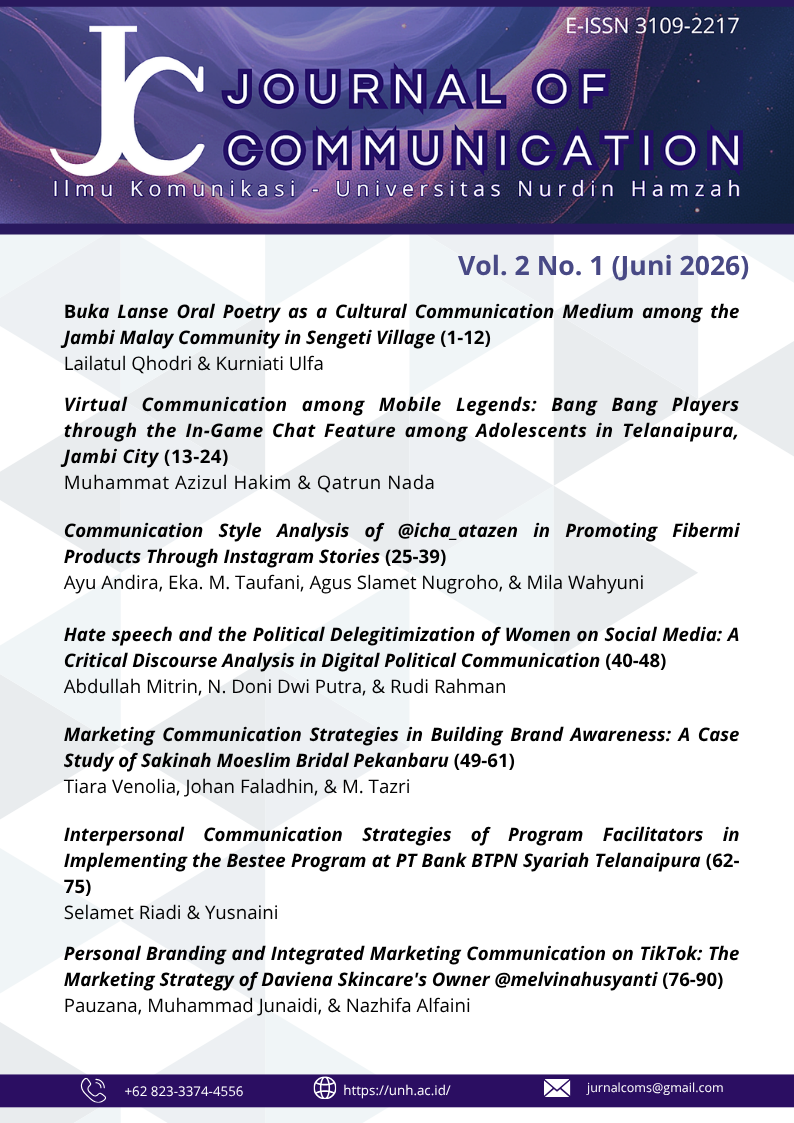
Hate speech and the Political Delegitimization of Women on Social Media: A Critical Discourse Analysis in Digital Political Communication
DOI:
https://doi.org/10.67155/joc.v2i1.65Keywords:
Digital Political Communication, Gender and Political Delegitimization, Hate speechAbstract
This study aims to analyze hate speech as a strategy of political delegitimization against women in digital political communication on social media. In recent years, the increasing participation of women in politics has not always been accompanied by equal acceptance, but rather by the rise of hate speech targeting not only their professional capacity but also their gender identity. This study employs a qualitative approach within a critical paradigm using Critical Discourse Analysis based on the framework of Norman Fairclough to examine how language is used to construct, reproduce, and legitimize gender inequality in digital political communication. The data consist of hate speech content collected from various social media platforms through purposive sampling techniques. The findings reveal that hate speech against women follows systematic discursive patterns characterized by gender stereotypes, the delegitimization of leadership capacity, and the shift of issues from political substance to personal aspects. Furthermore, the construction of gender within hate speech reflects a double standard that positions women as inferior political actors. In this context, hate speech functions not merely as an expression of hostility but as a strategic form of political communication that actively shapes public perception and undermines women’s legitimacy. The implications of this study highlight the importance of a critical approach in understanding the relationship between language, power, and gender, as well as the need for comprehensive efforts to address hate speech through regulation, digital literacy, and the strengthening of ethical political communication in the digital era.
References
Arzeti, D. S. D. P., Elviria, S., Muhaimin, M., Mairita, D., Pahrudin, H. M., & Maghfirah, N. K. (2025). Deconstructing the narrative of power: A critical discourse analysis of Tempo.co “Bagi-bagi konsesi tambang” in YouTube. Komunikatif: Jurnal Ilmiah Komunikasi, 14(2). https://doi.org/10.33508/jk.v14i2.7795
Ambarwati, P. (2025). Hate speech in digital space: A sociolinguistic analysis of gender-based expressions on social media. Jurnal Ilmu Komunikasi, 10(2), 45–60.
Banet-Weiser, S., & Miltner, K. (2022). Networked misogyny and hate speech in digital culture. Communication, Culture & Critique, 15(3), 1–10.
Citron, D. K. (2021). Hate crimes in cyberspace and gendered harassment. Harvard University Press.
Dutta, A., Banducci, S., & Camargo, C. Q. (2024). Online sexism and misogyny: A systematic literature review. Information Processing & Management, 61(1), 102–120.
Harmer, E. (2025). Incivility and abuse toward women politicians on social media. Political Communication, 42(3), 1–15.
Iranzo-Cabrera, M. (2025). Journalists’ ethical responsibility in tackling hate speech against women politicians on social media. Social Science Computer Review, 43(2), 1–18.
Jane, E. A. (2022). Gendered online abuse and its implications for democracy. Feminist Media Studies, 22(4), 1–14.
Kusumarani, R. (2025). Digital representation of women politicians in Indonesia. Wacana Politik, 10(1), 23–39.
Lim, M. (2021). Disinformation and digital media in political communication. Media, Culture & Society, 43(5), 1–15.
Mantilla, K. (2022). Gendertrolling: Misogyny adapts to new media. Praeger.
Peña-Fernández, S. (2025). Harassment and hate speech directed at journalists on social media. Journalism Studies, 26(4), 1–20.
Peron, F. (2025). Gender stereotypes in politics: Insights from social media analysis. Economics Letters, 240, 1–6.
Peron, F., & Mendes, G. (2024). Social media and gender bias in political communication. Journal of Political Marketing, 23(2), 145–160.
Sobieraj, S. (2021). Credible threats: Online harassment of women in politics. Oxford University Press.
Solovev, K., & Pröllochs, N. (2022). Hate speech in political discourse on social media. Journal of Information Technology & Politics, 19(3), 1–15.
Udupa, S. (2021). Digital hate and extreme speech online: Global perspectives. International Journal of Communication, 15, 1–20.
UN Women. (2025). Violence against women in the public sphere in the age of AI. United Nations.
Weißmann, S. (2025). Exposure to hate speech on YouTube: The role of platform and social characteristics. New Media & Society, 27(2), 1–22.
Downloads
Published
How to Cite
Issue
Section
License
Copyright (c) 2026 Abdullah Mitrin, N. Doni Dwi Putra, Rudi Rahman

This work is licensed under a Creative Commons Attribution-ShareAlike 4.0 International License.